
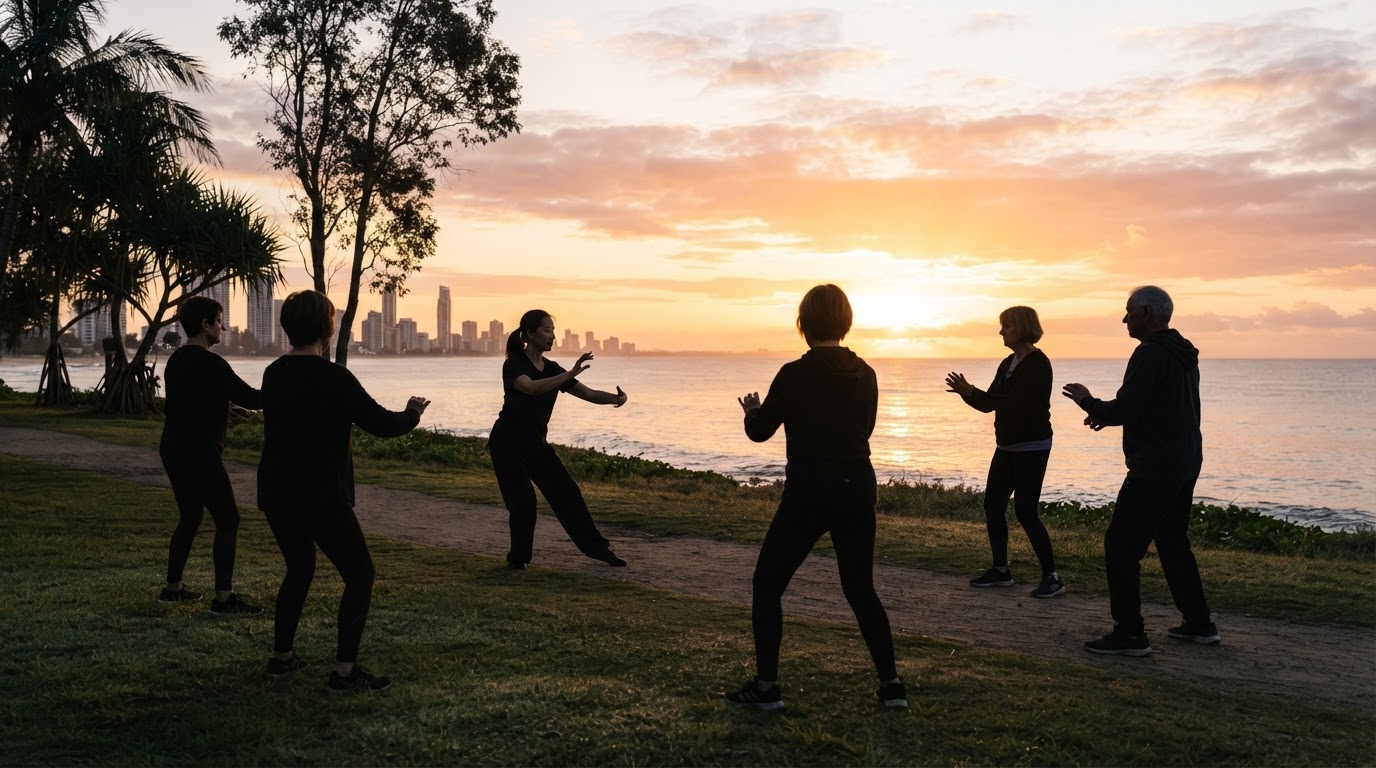
You follow a Tai Chi movement during class and it starts to make sense. Then the group turns, your hands change position and you find yourself wondering what comes next.
Learning a sequence can feel like juggling several instructions at once. There are steps to follow, directions to remember and movements to connect.
If you are beginning Tai Chi on the Gold Coast, you do not need to treat every forgotten movement as a setback. Instead, use those moments to identify what you need explained and how to approach the next lesson.
Find the point where you lose your place
“I cannot remember the sequence” can feel like a large problem. Identifying one specific gap makes it easier to discuss.
Perhaps you remember the opening movements but lose track after a turn. Maybe you know where your hands go but are unsure which foot moves first.
Tell your instructor exactly where the uncertainty starts. A question such as “What happens after we turn to the left?” provides a clear place to revisit, rather than asking yourself to relearn everything at once.
Ask to revisit a short section
Instead of trying to recall the whole sequence, ask which small section you should focus on. Your instructor can explain where that section begins and ends, and what matters most at your stage of learning.
Once it is clearer, ask how it connects with the movement before and after it. Those transitions can be the places where the sequence becomes confusing.
The aim is not simply to collect separate poses. It is to understand the order and how you move between them.
Use the teacher’s names and cues
Your instructor may use movement names, counting or short verbal cues. Ask what those cues mean and use the same language when making your own notes.
Mixing instructions from several sources can create unnecessary confusion, particularly when different styles use different sequences or terminology.
If a movement name does not help you remember what to do, ask the teacher to connect the name with the action. You do not need to learn specialist vocabulary without understanding what it refers to.
Check whether your view is causing confusion
Sometimes the difficulty is not remembering an instruction but seeing it clearly in the first place.
A person standing in front of you may block the instructor’s feet. A demonstration facing towards you can also make left and right harder to follow.
Ask where to stand and whether you can see the movement from another angle. Do not change position in a way that disrupts the group; let the instructor guide you to a suitable place.
A clearer demonstration may answer a question that repeated guessing would leave unresolved.
Keep notes brief and useful
After class, you might write down one or two points you want to remember. These could include a movement name, a cue the instructor used or a question for next time.
For example: “Ask when the weight shifts during the turn” is a practical note. Trying to describe every movement in detail may leave you with instructions that are difficult to interpret later.
If the teacher provides approved learning resources, ask how to use them. Seek permission before recording a demonstration, and avoid capturing other participants without their agreement.
Practise what is clear and ask about what is not
If you want to practise between classes, ask which material is appropriate to repeat independently. Stay with what you have been taught and understand, rather than filling in missing movements from guesswork.
When a detail becomes unclear, make a note and return to it with the instructor. You do not have to solve every question at home.
At your next lesson, explain what you practised and ask for feedback. Remembering an order and understanding the movement are related parts of learning, but they are not exactly the same thing.
Notice what you recognise now
You may still need reminders while recognising more of the sequence than you did initially. Perhaps a demonstration looks familiar, a cue now makes sense or you can identify the moment where you need help.
Those are useful observations. They allow you to describe your learning more precisely than saying you are either good or bad at remembering Tai Chi.
Ask your instructor what to focus on next. A clear direction is more helpful than comparing yourself with someone who has attended for years.
Learn Tai Chi on the Gold Coast
If you are curious about Tai Chi but worried about remembering the movements, contact us to discuss the available classes and how new students get started.
You do not need to know a sequence before enquiring. The purpose of a class is to give you somewhere to learn and ask questions.
Class details
Venue: [Insert venue and suburb] Class times: [Insert timetable] Enquiries and bookings: [Insert phone number or booking link]
Take the first step towards learning Tai Chi. Enquire about our Gold Coast classes today.
Ready to try Tai Chi?
Get in touch to learn more about our local Gold Coast classes and find out how to attend your first session.